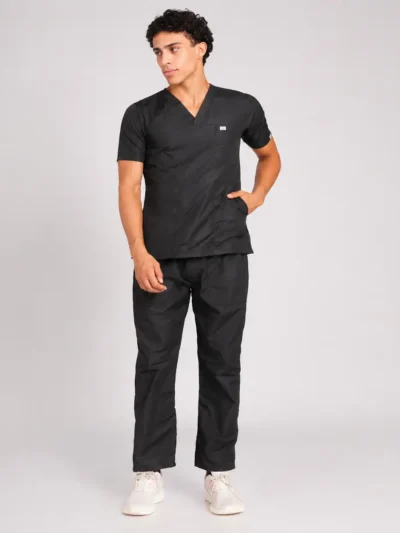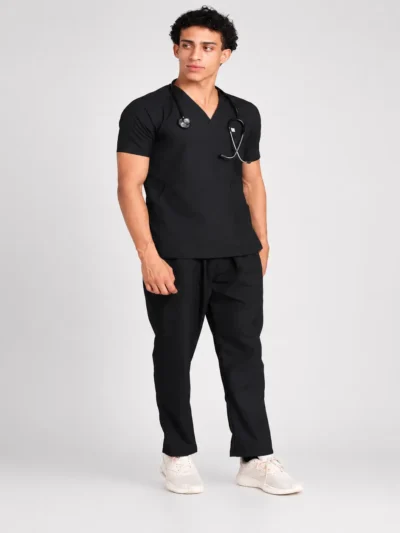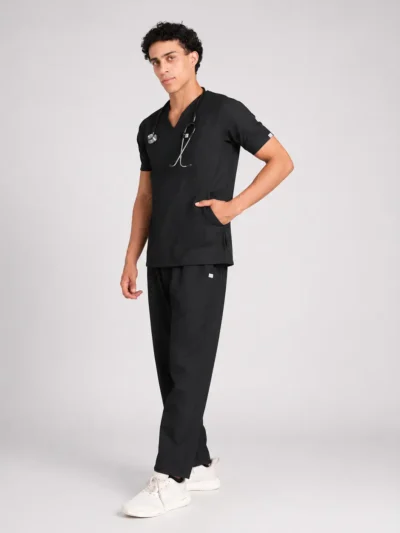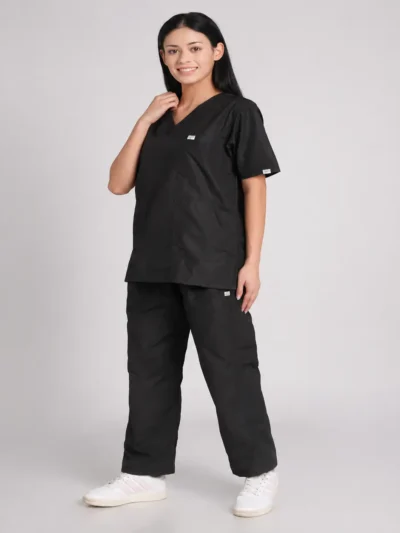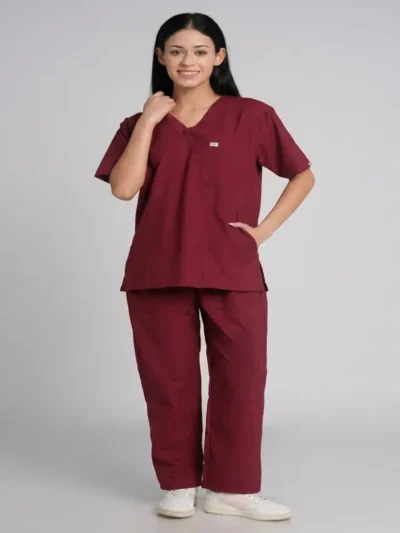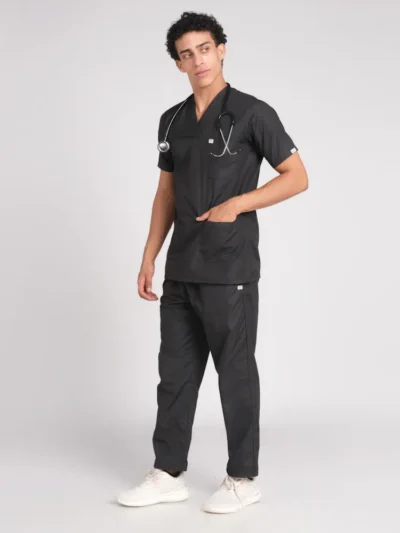


Ordering scrub suits in bulk for hospitals is more than simply choosing a color and quantity. Hospitals need uniforms that offer a practical combination of comfort, durability, easy maintenance, consistent sizing, professional appearance, and customization.
Whether you are purchasing scrubs for an operation theatre (OT), ICU, nursing team, doctors, diagnostic department, medical college, or clinic, planning the order properly can reduce sizing problems, avoid inconsistent batches, and make future reorders much easier.
Current Indian suppliers commonly offer bulk scrub programs with options such as multiple fabrics, standard and extended sizes, hospital logo embroidery, department color coding, and customized designs. However, MOQ, pricing, available sizes and production timelines vary from supplier to supplier, so these details should always be confirmed before placing an institutional order.
This guide explains what hospital procurement teams should check before placing a bulk scrub suit order.
Why Hospitals Prefer Bulk Scrub Suit Orders
For a hospital, buying scrubs in bulk can make uniform management more organized and consistent.
A planned bulk order can help with:
- Standardizing staff appearance
- Maintaining consistent department colors
- Simplifying future reorders
- Managing multiple sizes in one purchase
- Adding hospital or department branding
- Controlling uniform procurement costs
- Ensuring adequate replacement stock
- Reducing last-minute uniform purchases
For larger healthcare organizations, it is also useful to maintain an approved specification for fabric, color, stitching, sizing and branding. This makes repeat orders easier because the next batch can follow the same requirements.
Understand MOQ Before Placing Your Order
MOQ means Minimum Order Quantity. This is the minimum number of pieces or sets that a supplier needs for a product. It can be for a specific fabric, color, or customization. There is no single standard MOQ for all hospital scrub suppliers. For example, current Indian market listings show MOQs ranging from small institutional quantities to much larger production requirements, while some suppliers advertise bulk programs beginning at around 25–50 sets.
What can affect MOQ?
Your MOQ may depend on:
- Scrub suit design
- Fabric selected
- Number of colors
- Custom fabric or color requirement
- Hospital logo embroidery
- Printing requirements
- Individual name embroidery
- Special sizing
- Custom stitching or pattern
- Packaging requirements
- Total quantity
Important tip
Do not ask only, “What is your MOQ?”
Instead, provide the supplier with your complete requirement:
Product + quantity + sizes + colors + fabric + logo + customization + delivery location.
This gives you a much more useful quotation.
Calculate How Many Scrub Suits Your Hospital Actually Needs
Before requesting a quotation, prepare a department-wise requirement sheet.
For example:
| Department / Team | Staff | Sets per Staff | Estimated Requirement |
| OT / Surgical Team | 25 | 3 | 75 |
| ICU | 30 | 3 | 90 |
| Nursing | 50 | 3 | 150 |
| Laboratory | 15 | 2 | 30 |
| Emergency | 20 | 3 | 60 |
This is only an illustrative planning example. Your actual requirement should be based on staff strength, laundering frequency, shift patterns and replacement policy.
A practical procurement approach is to calculate the number of active staff first and then determine how many sets each person needs. Some hospital-uniform procurement guides suggest maintaining multiple sets per staff member so a clean uniform remains available while another is being laundered.
Choose the Right Scrub Suit Fabric
Fabric selection is one of the most important decisions in a bulk hospital uniform order.
Different healthcare environments can have different requirements, so the cheapest fabric is not necessarily the most economical choice over its full service life.
Common fabric options include:
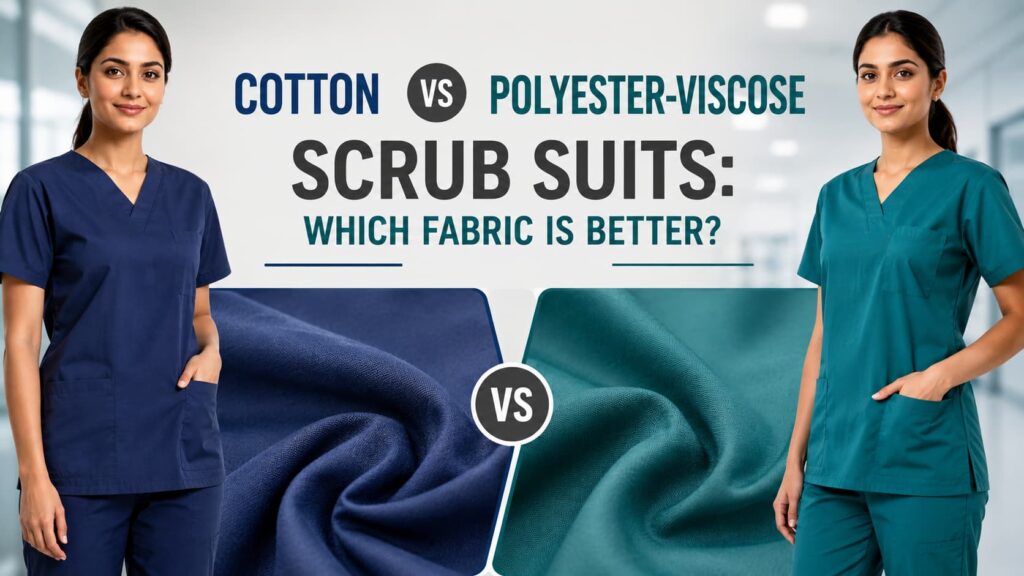
Cotton:
Soft and breathable, making it comfortable for long working hours.
Poly-Cotton:
A practical option when durability, easy care and cost control are important.
Performance or Stretch Fabric:
Useful where healthcare workers need greater freedom of movement.
Moisture-Wicking Fabric:
Designed to help manage moisture during long and physically demanding shifts.
Current medical scrub suppliers in India advertise cotton, polyester-cotton, rayon, stretch and performance fabrics depending on the product range.
What should hospitals ask the supplier?
Before approving the fabric, ask about:
- Fabric composition
- GSM
- Shrinkage
- Colorfastness
- Stitching quality
- Wash-care requirements
- Breathability
- Expected durability
- Suitability for repeated laundering
Best practice: Request a physical sample before approving a large production order.
Decide Between Unisex, Men’s and Women’s Fits
Hospitals should also decide whether they require:
- Unisex scrub suits
- Men’s fit
- Women’s fit
- Different trouser patterns
- Regular fit
- Relaxed fit
- Custom fit
Many suppliers now offer unisex as well as separate men’s and women’s options. For a large hospital, testing the fit on actual staff before production is particularly useful.
Choose Colors for Different Hospital Departments
Color coding can make it easier to visually distinguish healthcare teams.
For example, a hospital may choose different colors for:
- OT / surgical staff
- Nursing staff
- ICU
- Emergency
- Laboratory
- Housekeeping
- Administration
However, there is no universal requirement that a particular color must represent a particular hospital department. Each hospital can establish its own uniform policy.
Current Indian scrub suppliers commonly offer colors such as teal, hospital green, ceil blue, royal blue, navy, black, purple and other shades.
Procurement tip
When selecting a color, request a physical fabric swatch rather than approving a color from a screen. This helps avoid differences between digital images and the actual fabric.
Explore Customization Options
Customization can turn a standard scrub suit into a professional hospital uniform.
Popular options include:
Hospital Logo Embroidery
The hospital logo can be embroidered on the chest, sleeve or another approved location.
Staff Name
Names can be added for easy identification.
Designation
Examples include:
- Doctor
- Nurse
- OT Technician
- Anaesthesia Technician
- Lab Technician
Department Identification
The department name can be added to improve identification across larger facilities.
Custom Colors
Hospitals can request specific colors or color combinations to match their branding or internal uniform policy.
Custom Design
Hospitals with established uniform standards may request changes to:
- Neck style
- Pocket configuration
- Sleeve style
- Trouser design
- Waistband
- Drawstring
- Contrast piping
- Fit
- Length
Customization options such as hospital logos, individual names, department identification, colors and different designs are currently offered by multiple Indian scrub suppliers.
Common Mistakes to Avoid in Bulk Scrub Suit Orders
Ordering Without a Sample
A product can look good in a photograph but feel different when worn.
Using Only Generic Sizing
Different manufacturers use different measurements. Always work from the supplier’s size chart.
Ignoring Extended Sizes
A complete hospital uniform program should accommodate the full workforce rather than relying only on common sizes.
Choosing Fabric Only by Price
Consider durability, comfort, laundering and long-term use.
Approving Colors From Screens
Always check physical fabric swatches where color consistency matters.
Not Documenting Customization
Write down logo position, logo size, colors, embroidery requirements and design specifications.
Forgetting Reorder Specifications
Keep the original approved sample and size chart for future procurement.